On Sunday, I ran a 10K with a simple goal: finish the race.
The last race I ran was a half marathon in January, 2024. Since then I have been plagued with a shooting pain in my lower back and my left foot whenever I try to run. The injury started hampering my gym workouts. Multiple physios offered no clear diagnosis and no lasting relief. I stopped running completely, hoping rest would fix it.
Last November my wife signed us up for this 10K. Two weeks ago, in preparation for this run, I tried to run on the treadmill and the same issues came flaring back even before I had finished a kilometer. I stopped immediately and started walking. I tried a few more times but the same thing happened.
The 10K is a distance I could walk but that felt like a cop out. I also wanted to run because deep down I was tired of all the resting. I was confident my body could handle the run even without training. The real question was whether I would give in the moment it started hurting. My game plan was simple: find a pacer. Most organized races have them. I chose one running slower than I did in my heyday, but faster than my walk. Then lock in and follow till the finish. By following someone else’s pace, I was eliminating decisions.
Suddenly, the race became a test of my mental, not physical, fitness. Success depended entirely on sticking to the plan.
I loved that constraint. I’ve always craved focus. Every time I’ve experienced flow, it was because I shut out the world and committed to one thing. To me, multitasking is akin to inviting distraction. Multitasking doesn’t just divide attention. It also expands obligation. The moment you show you can do two things, the world assumes you can do three.
There were a few moments in the race where I was almost pulled away.
First, there was the opportunity to run freely on side roads and footpaths. The 10K is a popular distance and there are a lot of people running. The route never really opens up. You are constantly avoiding bumping into slower runners or people who have stopped mid-road to take selfies. My wife started to run on the footpath and asked me to join. I chose to stick right behind the pacer.
Then there was the plan to cross paths with our kids who would be on the road cheering for us around kilometer three. The run route passed right in front of our housing colony and we thought it would be fun for our kids to watch us run. Our nanny was supposed to bring our kids to a neighbour’s house which is on the main road, and then all of them were supposed to be standing on the road to witness the spectacle and cheer us on. When we reached the designated point, I could only see our neighbour and their child. Our children were nowhere in sight. As I ran past, my neighbour assured me that the kids were fine, they were just late. For a split second, I wanted to slow down and wait for them. I would have still completed the race but that would have meant losing my pacer.
After kilometer four, the hydration stations were all empty and it was a big blow. With each passing kilometer I was feeling more and more dehydrated. I began convincing myself I was on the path to cramping. I was very tempted to go searching for a public water dispenser or find someone willing to spare some water. But every option came with the possibility of losing the pacer.
Though in pain, it felt great to complete a 10K after close to two years. The biggest gain was the insight about single-tasking. Single-tasking isn’t just about doing one thing. It’s about giving yourself permission to ignore everything else. In a world of endless options, constraint can feel like freedom.
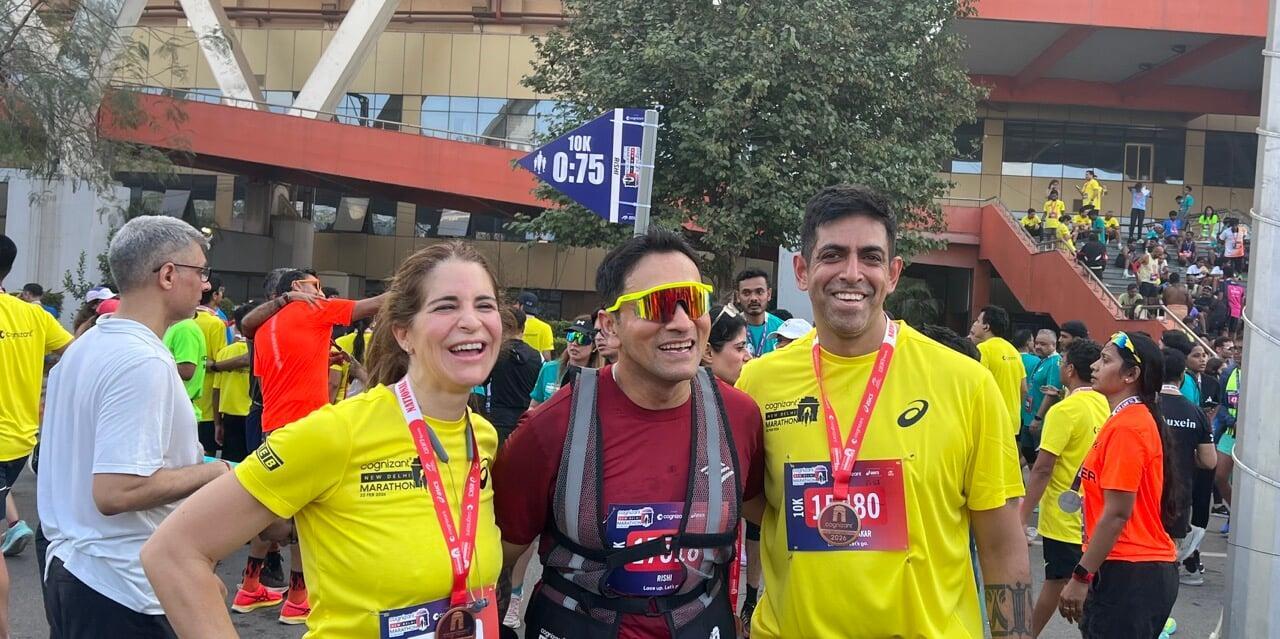
Sole and me with Rishi, the Pacer!